
Value-Based Trials For AI Products Make Sense
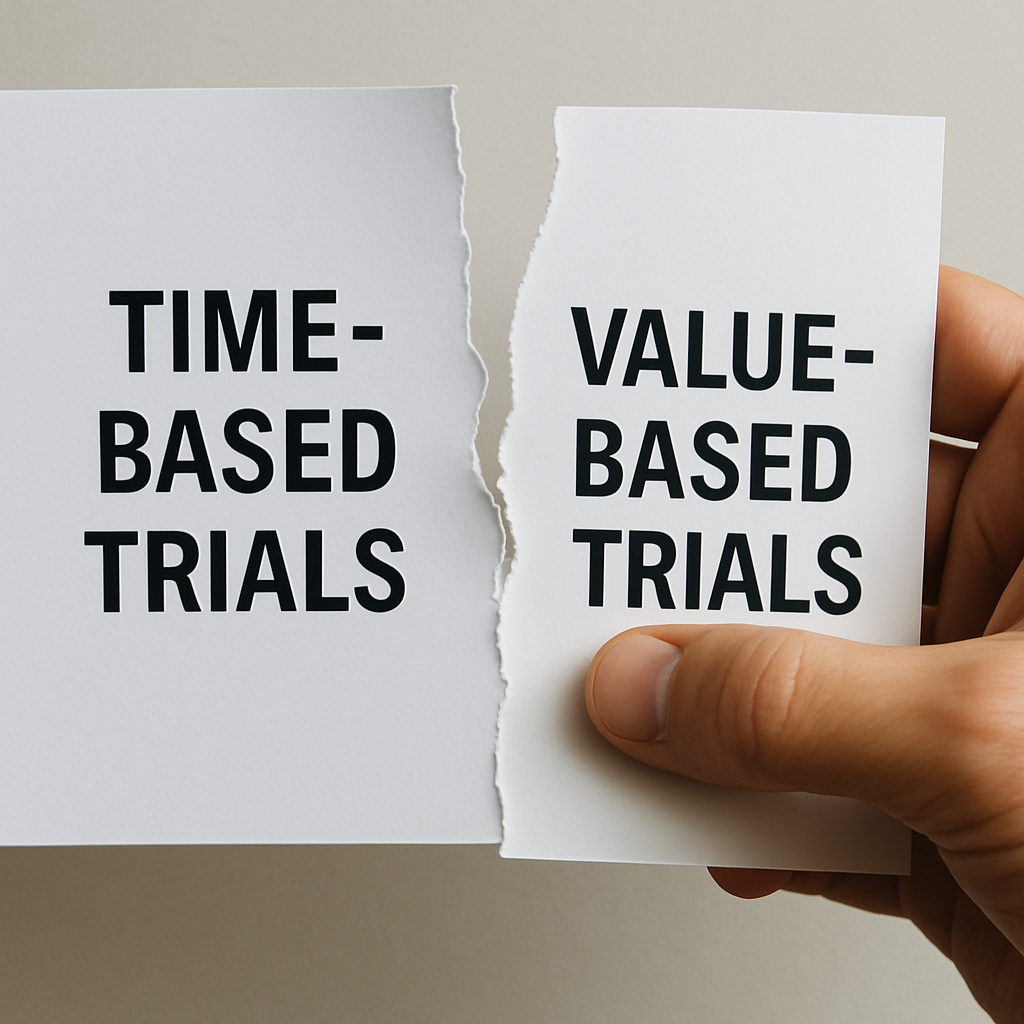
Time-Based Trials Are Losing Their Usefulness
Time-based trials don’t tell you much about whether a product actually works. In a 14-day window, one user might barely log in, another might burn through everything in an afternoon, and plenty sign up just to grab a resource or join a list. None of that maps to real value or tells you if the product is sticky.
There’s a reason SaaS still leans on a 14 day / 30 day trial period. Time-bound trials produce predictable activation patterns and the kind of benchmark-friendly metrics venture-backed companies rely on. Faster sales cycles and cleaner forecasting are exactly what VC playbooks push founders toward [1].
But the market is shifting. Subscription fatigue is now ALSO a B2B problem. Buyers are overwhelmed with overlapping tools and stacked monthly fees—enough that the FTC’s recent “Click-to-Cancel” rule directly calls out frustration with SaaS renewals [2][3]. (there is a bull case here for an era of "bundling").
“Software is becoming a tax on productivity,” as one analyst put it. This is why usage-based and value-based pricing have exploded. Over half of SaaS companies now use some form of usage-based model, and the percentage grows yearly [4].
Why Value-Based Trials Make More Sense
A value-based trial defines access by output, not time.
- 10 posts
- 3 blogs
- 50 lead pulls
When someone uses those credits, I know they touched the core of the product. If they found value, they upgrade. If they didn’t, they walk. No countdown timers, no false urgency, no inflated conversions that convert into churn later.
Chargebee calls these “paywalls that appear only after value is realized,” and they outperform traditional time-bound trials consistently [5][6].
Magic Numbers: What Great Products Learned
While I don’t know yet whether 10 posts or 3 blogs is the right activation threshold, great companies discovered their magic numbers through usage, not timers:
- Facebook: 7 friends in 10 days → strong retention
- Slack: ~2,000 messages per workspace → team becomes sticky
- Twitter: ~30 followed accounts → onboarding success (team lore)
- Dropbox: 1 file in 1 shared folder → core “aha” moment
These were behaviors discovered at scale. I do wonder (and hope!) they can be discovered earlier. A value-based trial creates this opportunity for discovery without a data science team looking at product analytics.
What You Learn From a Value Trial
1. You find the real stickiness threshold
Every product has a point where it “clicks.” Maybe it’s 20–30 scheduled posts. Maybe it’s 5–7 published articles. You don’t guess; you observe! Usage rises, the limit kicks in, and users either upgrade or leave. But at the very least, they used the damn product!
2. You protect yourself from heavy AI users
AI tokens are getting cheaper, sure, but they ain't free. A single power user can burn $20–$30 in a day. I can do double that easily.
A value trial caps that. Heavy users hit limits fast—which is usually a good sign (or fraud lol).
3. You convert users at the moment of highest engagement
People upgrade when the tool is working, not when a countdown ends.
Value trials force that moment to appear naturally.
How Endless Will Use Value-Based Trials
Endless Posts
A fixed number of scheduled posts. Once the buffer fills, the value is obvious.
Endless Blog
3–5 AI-generated posts. If users publish them, the product has proven itself.
Endless Startups
A handful of daily startup discoveries. Enough to demonstrate value.
This aligns incentives. Heavy users pay more. Light users cost less. The trial maps directly to value creation.
Why Builders Should Care
If your product’s value comes from usage, your trial should too. It exposes activation patterns, separates serious users from browsers, controls AI costs, and gives you retention data that actually predicts long-term success.
The next step for me is simple: turn on billing, ship the credit system, and let usage—not calendars—drive revenue. This is where modern SaaS is headed, especially for AI products.
Strong position, weakly held. I’ll publish data once I have it.
Sources
[1] Ordway Labs – SaaS Trial Length & Conversion
[2] LinkedIn – Subscription Fatigue in SaaS
[3] Frisbii – Why Subscription Fatigue Is Rising
[4] Aalto Capital – Shift to Usage-Based Pricing
[5] Chargebee – Usage- vs Time-Based Trial Models
[6] GTM Strategist – Reverse Trials & Value-Based Activation