
Noco.io - post mortem
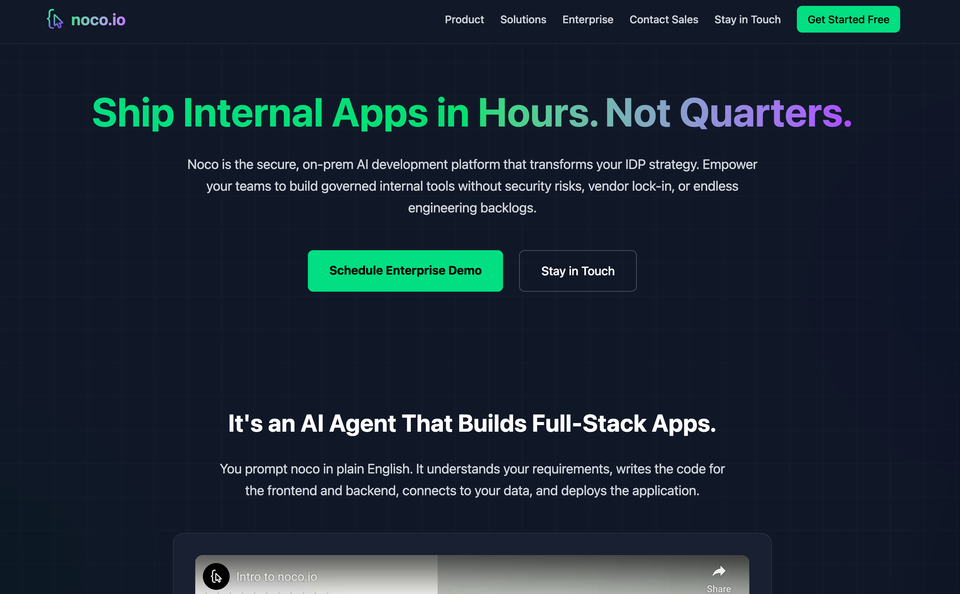
$5K in Credits and 4 Months Building a Lovable Competitor That Went Nowhere
TLDR;
- if you have a product whose output quality is directly correlated with your users ability to prompt effectively .... god help you
This one stings in a very specific way. I spent four months on it — including writing code on my honeymoon like an idiot — and burned about five grand in credits to build a Lovable competitor I genuinely believed in. And it went absolutely nowhere.
The concept looked good on paper: a cloud dev environment where indie founders and non-technical folks could “vibe-code” full apps. I figured there was room for a fast, real alternative to Lovable that could build stuff that ACTUALLY WORKED!
allow me to nerd out for a sec: Mine spun up a dedicated Kubernetes pod per user, fully isolated, with its own DB credentials and VS Code in the browser. It was a real environment. You could build something, deploy it wherever you wanted, and shut the whole pod down when you were done. It cost a few hundred bucks a month and actually worked.
But nobody cared.
Not only did nobody care — nobody could even use it. People didn’t know how to ask an AI to build anything for them. They didn’t know what to type. Watching this in real time broke my brain a little. The prompts people used were comically bad. Like I hope to god they had a diagnosable metnal illness because the alternative explanation is just too depressing...
The Market
Here’s what I missed: the Lovable crowd doesn’t want to build apps. They want to feel like they built apps.
“Clone Netflix” became a screenshot they could tweet to prove they were grinding. Push a button, get a shiny red site, post it on social — and never notice that nothing actually worked. Not the buttons. Not the forms. Nothing!
But it looked like progress. That was enough.
Meanwhile, my tool actually created real, functioning web apps. You could deploy them. You could scale them. It even supported multi-tenancy — which, in hindsight, is hilarious, because try explaining multi-tenancy to someone who’s never built a CRUD app.
So of course: zero traction. The same people who clicked around happily in Lovable were instantly confused by my product. It looked similar, sure, but it required actual prompting. Real interaction. And their prompts… my god. Their prompts drove me insane.
This is exactly why Endless Posts and Endless Blog generate onboarding prompts for users. I’ve learned the hard way: if your product depends on good prompting, you’re dead. I’ll probably never trust users to write their own prompts again.
The Unit Economics Problem
Even if the product had landed, the economics didn’t. At $20 a month, the unit economics on tools like this are rough. You need thousands of paying users before anything makes sense. And code generation is expensive — LLM tokens aren’t free, and you can’t get away with sloppy output because code has to actually run.
Honestly, in hindsight, you’re better off selling a commodity product than chasing a dev-tool that needs perfect accuracy and perfect distribution for only $20 a month per project. like supabase for instance ... similar consumer pricing ... but wildly different gross margins.
The Grind
I did the thing you’re “supposed” to do.
Twenty to fifty cold DMs a day.
Comments on every Product Hunt launch I could find.
Cold email.
Months of it.
None of it caught.
It was another reminder that distribution beats everything — product, design, architecture, the whole deal. If people aren’t sharing your product with someone else, nothing moves. And my users weren’t getting enough value to talk about it.
It reminded me of SuperSend. Plenty of people didn’t buy it to send emails; they bought it to look like they were sending emails. They wanted screenshots. Progress they could show to their boss. Lovable nails that illusion. I tried selling the real thing. The market didn’t want real.
The Bitterness (and the Reality)
What makes this one frustrating is how long I stuck with it. I thought it was finally the project I could go long on.
Started in February.
Shut it down November 16.
Nine months of (fairly) consistent effort — more than most of my projects ever get — and nothing.
I remember reading about Vanta’s early days, about how they “wandered in the dark for six months” before finding product–market fit. Six months. Try six years. Try doing it at 33 instead of 23. It's hard to feel empathy for these stories sometimes.
But that’s the reality: the leader tends to keep leading. Even in markets that aren’t winner-take-all, mindshare compounds. Lovable owns the vibe-coding crowd for now. Cursor, Claude Code, and maybe Replit will chip away, but I doubt a newcomer can wedge in without a miracle.
The Ending
Today I shut it down. Bittersweet doesn’t even cover it. The architecture was genuinely cool, the tech worked, and I learned a lot. But the market didn’t care, and distribution never showed up.
To everyone who tried it — sincerely, thank you. I mean it.
And then, in a weird twist, it wasn’t a loss at all.
Right as I was killing the project, I ended up getting a job at Motion — where I’m literally building a website builder. The very thing I tried (and failed) to build independently turned into the thing that got me hired. Zero to one ROI on this project: absurdly good.
Four months of work, a few thousand in credits, and I ended up with a job where the architecture, the experiments, and all the frustration actually matter. The product flopped, but the path it pushed me onto was worth it.
Painful project. Disappointing traction.
But a solid ending.
Sometimes the upside isn’t the product.
It’s where the product takes you.